“Today, I drank coffee at a cafe.” (今日はカフェでコーヒーを飲んだ。)
Take a quiet look at this simple, everyday Japanese sentence.
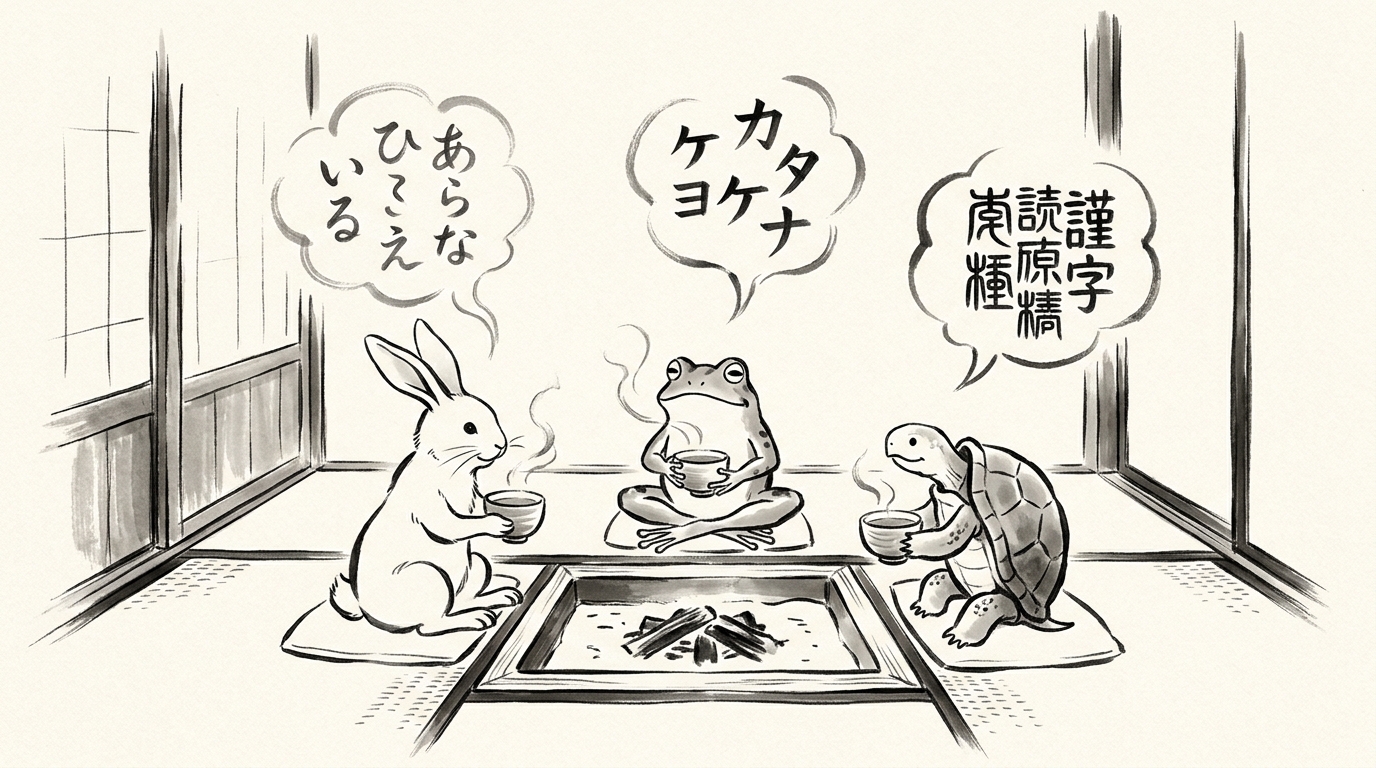
Within these few words, three completely different writing systems live side by side:
- The solid, angular 【Kanji】 (今日, 飲)
- The soft, fluid 【Hiragana】 (は, で, を, んだ)
- The crisp, geometric 【Katakana】 (カフェ, コーヒー)
Across the entire globe, it is extraordinarily rare for a language to effortlessly weave three distinct scripts—each with its own history, aesthetic, and psychological role—into a single sentence.
Why did Japanese evolve into such a sophisticated, multi-layered system? Where did each script come from? And what kind of visual magic emerges when these three systems operate in harmony?
Here are the three doorways into the landscape of written Japanese.
The Three Scripts: Origin and Architecture
1.Hiragana (ひらがな) — The Flowing Breath of Emotion
Hiragana acts as the organic tissue of Japanese prose. Functioning primarily as grammatical particles (は, が, を, に) and verb inflections, it weaves between the dense anchors of Kanji like a stream flowing past river stones.
Born roughly 1,200 years ago during the Heian period, it emerged naturally as ordinary writers simplified Chinese cursive calligraphy, rubbing away sharp corners until pure, looping curves remained. Once dismissed by court men as informal “women’s hand” (onnade), it was embraced by female literary geniuses like Murasaki Shikibu (The Tale of Genji), forming the very emotional backbone of Japanese literature.
The immortal Iroha poem, which uses all 47 syllables of the script exactly once without repetition, embeds the profound Buddhist philosophy of impermanence (Mujo) directly into the alphabet itself.
2.Katakana (カタカナ) — The Pragmatic Gateway to the World
Katakana is the designated script for modern foreign loanwords and onomatopoeia. Words like “coffee” (コーヒー), “smartphone” (スマートフォン), or acoustic heartbeats (ドキドキ) are instantly flagged by Katakana’s sharp lines as external concepts or raw sensory sounds.
Though largely associated with modern pop culture today, Katakana was actually born in the 9th century inside quiet Buddhist temples. Scholarly monks needed high-speed shorthand to annotate Classical Chinese sutras within microscopic margins, so they sliced off single pieces of Kanji characters with scalpel-like precision.
Prior to World War II, Katakana served as the official, masculine script of imperial edicts and telegrams. Today, it operates as Japan’s frictionless import harbor, transcribing vocabularies from every corner of the earth.
3.Kanji (漢字) — The Anchors of Meaning and History
Kanji is an ideographic system where entire concepts, physical silhouettes, and philosophical worlds are locked inside architectural square frames. Unlike phonetic kana, characters like “turtle” (亀), “mountain” (山), or “love” (愛) carry independent meaning within their very structure.
Tracing its roots back over 3,000 years to oracle bone divinations carved onto tortoise shells in ancient China, Kanji crossed the sea to Japan around the 5th century. The Japanese ingeniously hacked this foreign system by inventing Kun-yomi (mapping native Japanese sounds onto imported characters) and even minted their own native characters (Kokuji), such as 畑 (dry field), 峠 (mountain pass), and 雫 (water drop).
While the standard Joyo Kanji list taught in schools contains 2,136 characters, the ocean beyond is boundless—filled with complex characters like 魑魅魍魎 (chimi-mōryō, spirits and demons) that challenge even highly educated native speakers.
The Miracle of Coexistence
The true genius of written Japanese lies not merely in having three scripts, but in how writers can shift the emotional temperature of a word simply by toggling between them.
Consider the single word for Japan’s iconic cherry blossom:
- 桜 (Kanji): Traditional elegance, ancient roots, the stoic dignity of nature.
- さくら (Hiragana): Spring warmth, tender nostalgia, childlike softness.
- サクラ (Katakana): Modern graphic design, clinical detachment, or the slang for an undercover shill.
The biological flower referred to is identical. Yet the visual silhouette of the script alters the voice, tone, and psychological distance of the sentence.
The choice of script is part of the meaning.
Dense Kanji anchors semantic weight; flowing Hiragana orchestrates cadence and human breath; sharp Katakana catches the fresh winds of the outside world.
Because these three scripts coexist in breathtaking equilibrium, written Japanese achieves a visual depth, narrative texture, and information density found nowhere else on earth.