Take a quiet moment to look at the character for turtle: 亀 (Kame).
The head poking out at the top. The segmented grid of the shell in the center. And the tail extending from the bottom.
Once you know what to look for, this angular character suddenly reveals itself: it is a stylized sketch of an actual turtle seen from above.
This touches the very soul of what makes Kanji unique.
While alphabets, Hiragana, and Katakana were developed to record the fleeting sounds of speech, Kanji was born to trap the visible world and its meanings inside a silent, architectural frame.
It began by drawing the shapes of animals, mountains, and rivers, eventually evolving to capture invisible human emotions and abstract philosophies within structural strokes.
And across more than 3,000 years, the ancient marks carved into literal tortoise shells excavated from the dry soil of China still form the living skeleton of the sentences we read today.
The Oracle Bones: It All Began on a Tortoise Shell
More than 3,000 years ago, an ancient Chinese dynasty known as the Shang (殷) flourished along the Yellow River. The earliest surviving records of written characters were discovered millennia later, etched into the plastrons of tortoises and the shoulder blades of oxen.
These are known as the Oracle Bone Script (甲骨文字, Kōkotsu-moji).
These marks were not born for literature or commerce; they were carved for divination. Before a king made a fateful decision, diviners applied scorching heat to prepared bone. As the surface cracked, the king interpreted the fissure lines as an oracle. Then, using bronze knives, scribes incised the query and the omen directly into the bone.
These magical, talismanic carvings are the direct linear ancestors of the Kanji used today.
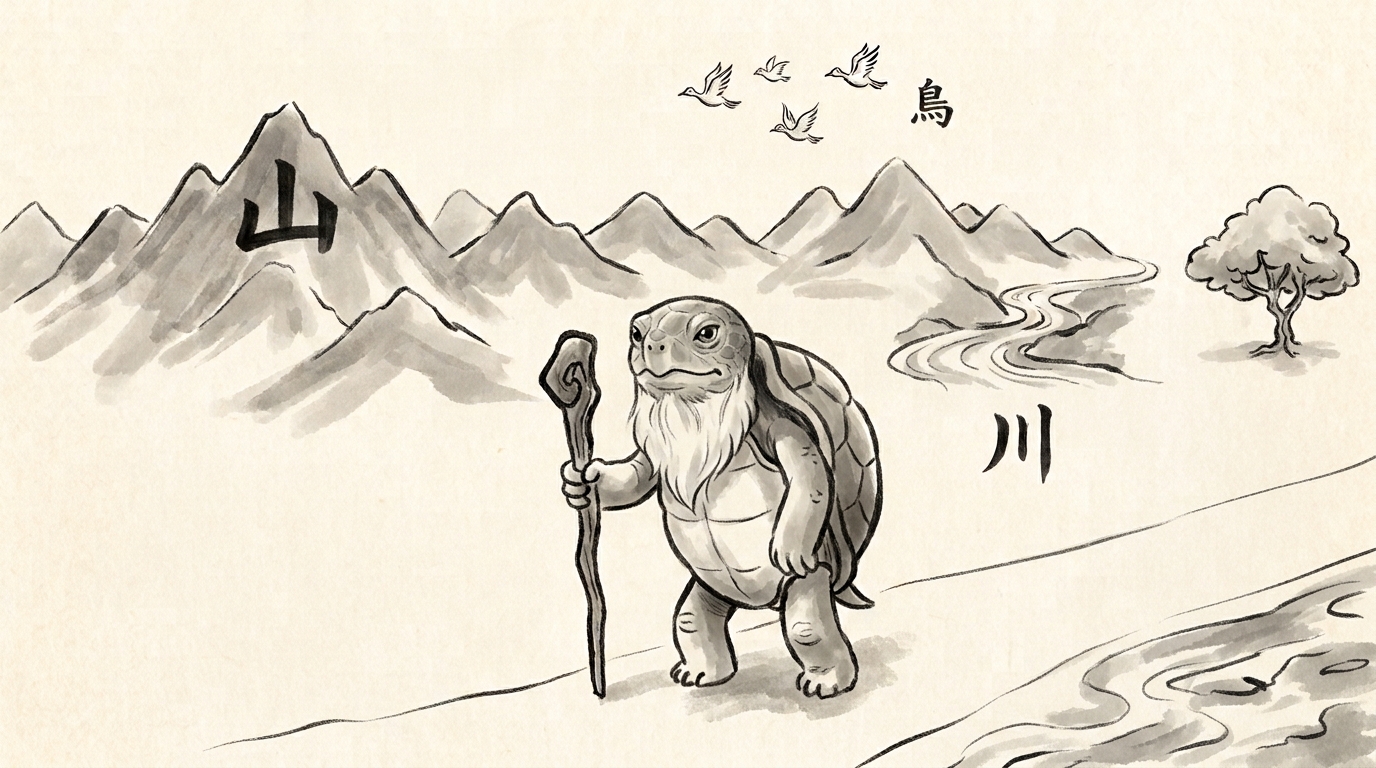
Early oracle characters were pure pictograms (shōkei-moji). “Sun” (日) was a circle with a solar dot; “Moon” (月) was a slender crescent; “Mountain” (山) traced three jagged peaks; “River” (川) captured the curving flow of water.
Even when placed beside modern characters, the ancient gaze upon the natural world remains unmistakable.
Over thousands of years, pictograms gradually absorbed abstract philosophies, refining into the balanced, architectural brushstrokes of modern regular script (Kaisho). Though the outer lines evolved, the ancient human attempt to make sense of the cosmos still pulses within every stroke.
An Ancient Search Engine: The Brilliant UI of “Radicals”
Confronted with thousands of complex characters, foreign learners frequently feel overwhelmed: “How could any human brain memorize an infinite sea of arbitrary patterns?”
Yet a closer look at the architecture of Kanji reveals an astonishing information architecture engineered by ancient minds.
This system is built upon Radicals (部首, Bushu).
In modern computing terms, radicals are essentially embedded hashtags or pre-sorted semantic folders hardcoded directly into each character.
For example, whenever you see the three-drop water radical (氵, Sanzui) on the left side of a character, you can infer that the word relates to water or liquid, even if you have never encountered the character before (海 ocean, 波 wave, 泳 swim, 湖 lake, 涙 tear, 酒 sake).
A tree radical (木) immediately signals plants, wood, or carpentry (森 forest, 林 grove, 机 desk, 橋 bridge). A heart radical (忄 or 心) signifies mental states, emotions, or intellect (怒 anger, 怖 fear, 情 feeling, 快 pleasant).
Ancient people categorized the entire observable universe into modular building blocks.
Kanji is not a chaotic blizzard of random lines. It is an exquisitely designed, visually indexed user interface (UI) where semantic folders open instantly at a glance.
Crossing to Japan: Hacking an Alien Script via “Kun-yomi”
Kanji crossed the seas to the Japanese archipelago around the 5th century CE. Because the ancient Japanese had no indigenous writing system of their own, Kanji was imported as a foreign script for studying continental civilization, statecraft, and Buddhist theology.
Then began an epic struggle between language and script.
Chinese and Japanese share no linguistic lineage. Their grammar, word order, phonology, and sentence structures are radically different. Forcing one language’s script onto an entirely different tongue naturally created massive structural friction.
To solve this, ancient Japanese scholars pulled off an unprecedented feat of cross-cultural hacking: the invention of Kun-yomi (訓読み, native Japanese readings).
To understand this in English terms, imagine importing the Latin word Aqua directly into written English:
- In formal scientific vocabulary, you pronounce it as Latin: “Aqua” (similar to Chinese-derived On-yomi).
- But when reading everyday prose, you point to the letters Aqua and pronounce your own native Germanic word: “Water” (similar to native Kun-yomi).
When the character for “mountain” (山) arrived, Japanese readers did not merely borrow its Chinese pronunciation, San (On-yomi). They also mapped their own native ancient word, Yama, directly onto the exact same character (Kun-yomi).
The shape was borrowed from the Asian mainland. But the living soul inside was native Japanese.
Because of this remarkably flexible compromise, a single Kanji character came to possess multiple distinct readings. The single character 行, for example, carries Chinese-derived readings like Kō (行動 action), Gyō (行列 procession), and An (行脚 pilgrimage), alongside native Japanese readings like I-ku (行く to go) and Okonau (行う to conduct).
For international students, navigating this labyrinth of dual readings is famously demanding. Yet it stands as a testament to the sheer ingenuity with which the ancient Japanese naturalized a foreign technology into their cultural bloodstream.
Characters Invented in Japan: The Creativity of “Kokuji”
After centuries of writing with Kanji, the Japanese took an even bolder step:
“If no existing character expresses the reality of our daily life, why not simply invent our own?”
Thus were born Kokuji (国字, national characters)—ideograms conceived entirely in Japan that never existed in China.
A prime example is the character 畑 (Hatake, dry crop field). In China, the single character 田 (Den) covered both wetlands and dry fields. But for the Japanese, whose society revolved around irrigated rice paddies, distinguishing dry farmland cleared by slash-and-burn fires from wet paddies was critical. So they fused “Fire” (火) and “Field” (田) together to invent 畑.
Other iconic characters born from Japanese observation include:
- 峠 (Tōge, mountain pass): The exact crest of a mountain trail where ascending turns into descending. Hence: Mountain (山) + Up (上) + Down (下).
- 働 (Hataraku, to work): A human being actively in motion accomplishing a task. Hence: Person radical (亻) + Move (動).
- 雫 (Shizuku, a water drop): Rain trickling downward. Hence: Rain (雨) + Down (下).
Even within the 2,136 Joyo Kanji taught in modern Japanese schools, several home-grown Kokuji proudly stand alongside their ancient continental cousins. To embrace a foreign script, master it, and eventually forge new characters to reflect your own geography—this creative adaptation captures the very essence of Japanese culture.
Shared Characters, Divergent Meanings: Historical Drift and Shared Vocabulary
While China and Japan continue to share the same script, centuries of historical divergence have caused identical characters to drift in fascinating directions:
- 手紙: In Japanese, it means a heartfelt, handwritten letter (Tegami). In modern Chinese, it commonly refers to toilet paper or tissue.
- 娘: In Japanese, it means daughter (Musume). In Chinese, it traditionally denotes a mother, aunt, or elderly woman.
- 汽車: In Japanese, it evokes a vintage steam locomotive (Kisha). In modern Chinese, it means an automobile (Qìchē).
These differences reflect how each society shifted its vocabulary over time.
Yet modern history saw an even more dramatic plot twist: the cross-pollination of modern terminology.
Following the Meiji Restoration in the late 19th century, Japanese intellectuals worked furiously to translate Western political, philosophical, and scientific treatises into East Asian terms. To do so, they coined thousands of new compound words using classical Kanji building blocks:
哲学 (Philosophy), 経済 (Economy), 社会 (Society), 科学 (Science), 自由 (Freedom), 権利 (Rights), 心理学 (Psychology), 文化 (Culture).
These were all “Wasei-Kango” (Japanese-minted Chinese words). Later, during the late Qing dynasty, these modern translations crossed the sea to China, becoming widely adopted into modern standard Chinese vocabulary for social and scientific discourse.
Characters that journeyed from the mainland to Japan donned the mantle of modern world knowledge, then crossed the sea once more to be shared across East Asia. Kanji is not a closed relic of the past; it is a living bridge that has never ceased its dialogue.
A Universe of 2,136 Characters—and the Abyss Beyond
In modern Japan, the Ministry of Education designates 2,136 Joyo Kanji (regular-use characters). Mastering these unlocks the vast majority of newspapers, street signs, and contemporary literature.
Yet 2,136 characters is merely the shore of a vast ocean.
In classical literature, historic place names, personal names, and specialized arts, thousands of characters outside the Joyo list continue to live.
Nowhere is this clearer than in phrases like 魑魅魍魎 (Chimi-mōryō).
Referring to malevolent mountain spirits, river demons, and devious tricksters lurking in the shadows, all four characters lie completely beyond everyday educational standards. Even highly literate native Japanese speakers find these characters extraordinarily difficult to read and write without checking a dictionary, making them a legendary staple of television quiz tournaments.
Even native speakers spend lifetimes expanding their literacy. That bottomless depth and cultural weight is precisely why Kanji continues to inspire quiet awe and intellectual romance.
How Kanji Anchors the Landscape of Japanese
Consider this simple, humble sentence:
今日は空が青かった (Today, the sky was blue.)
Blocky, muscular 【Kanji】 (今日 / 空 / 青) rises up with instant semantic clarity, while fluid, curving 【Hiragana】 (は / が / かった) effortlessly threads them together like a river winding past ancient stones.
The fact that written Japanese requires zero spaces between words is entirely thanks to Kanji.
Without Kanji, the Japanese eye would wander through a blur of phonetics, searching desperately for word boundaries. Because Kanji drops heavy, unambiguous anchors of meaning onto the page, Japanese text achieves a visual rhythm and high-speed scanability found almost nowhere else in the world.
Phonetic letters (Hiragana and Katakana) dancing alongside ideographic symbols (Kanji).
Two completely contrasting systems living together on the same sheet of Washi paper, elevating each other’s beauty.
More than 3,000 years ago, an ancient king carved divinations into a scorched tortoise shell. Those marks still endure today—transformed, refined, and quietly holding up the deepest foundations of human thought.