“Coffee,” “television,” “smartphone,” “robot,” “algorithm.”
To anyone familiar with written Japanese, the script used for these words is immediately unmistakable: Katakana (カタカナ).
One of the first rules foreign learners encounter when studying Japanese is simple: Katakana is the script used for loanwords imported from other languages.
Look around modern Tokyo today, and that rule seems indisputable.
Yet turning back the pages of history reveals a startling truth.
When Katakana was first created, it had absolutely nothing to do with foreign words.
This sharp, geometric script was not born at the imperial court, nor at bustling merchant seaports.
It originated over a thousand years ago, in the dim quiet of ancient Buddhist temples—scratched into the razor-thin margins of sacred Chinese scrolls.
The Origin: Tiny Shorthand in the Margins of Sutras
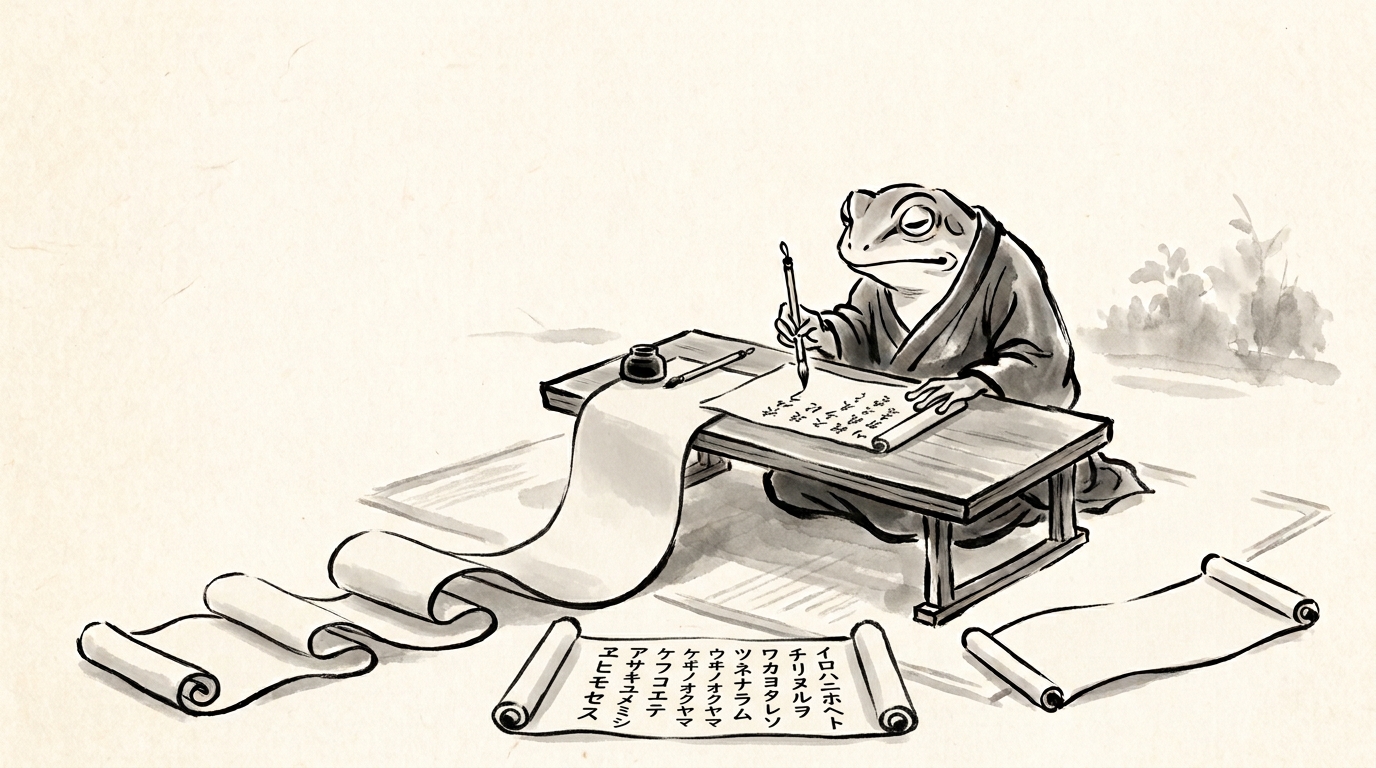
Around 1,200 years ago during the Heian period, as the scholarly study of Buddhist texts deepened across the country, monks faced a formidable linguistic hurdle.
The Buddhist sutras arriving from the Asian mainland were written entirely in Classical Chinese.
The monks’ mission, however, was to read, comprehend, and recite these intricate scriptures in their native Japanese tongue.
To do this, they began annotating the texts, jotting down tiny guide marks directly beside the Chinese characters and between the dense vertical lines. These scribbles served as practical guideposts: “Pronounce this character like this,” or “Invert the grammatical order here.”
There was just one problem: the margins of these sacred scrolls were microscopic. There was simply no room to write out fully formed Chinese characters.
So the monks devised an intensely pragmatic, revolutionary shortcut: they sliced off a single fragment of a Kanji character and threw the rest away.
For instance, they sliced off the left radical of the character 阿 to create ア (a). They clipped the left half of 加 to invent カ (ka). They took the right stroke of 伊 to form イ (i).
While court women were creating Hiragana by smoothly melting Chinese characters into flowing, cursive loops, the monks took the exact opposite approach.
If Hiragana is Kanji melted into curves, Katakana is Kanji sliced with a scalpel.
Katakana’s angular, sharp-cornered profile exists because it was designed as high-speed, space-saving shorthand—engineered so that even when drawn at microscopic scale, it could never be misread.
While Hiragana flourished privately in the emotional letters and diaries of court women, Katakana was forged in temple study halls as a monk’s ultimate tool of academic efficiency.
The Former Script of Empire and Officialdom
In the modern imagination, Katakana often carries a casual, pop-culture vibe—evoking neon billboards, sci-fi anime, and Western fashion brands.
Yet rewind the clock just a century to pre-World War II Japan, and you find a completely inverted reality.
During the Meiji era and up through the 1940s, official government edicts, legal statutes, and the cutting-edge telegraph system were written primarily in Katakana.
“Submit the official report regarding this matter immediately.” (コノケンニカンスルホウコクショヲテイシュツセヨ)
Combining dense Kanji with rigid Katakana was, at the time, the ultimate expression of state authority and masculine formality.
There was a technical reason for this: early Morse code and telegraph systems required a script that was visually stark, mechanically distinct, and had fewer complex strokes than Hiragana. Katakana was the language of modern technological precision.
It was only after World War II, following sweeping language reforms that standardized Hiragana-based vernacular for schoolbooks and civil law, that Katakana was relieved of its duty as the voice of the state.
Stripped of its bureaucratic burden, Katakana pivoted toward an entirely new destiny:
Becoming Japan’s universal sponge for foreign ideas.
The Ultimate Linguistic Port: Importing Sounds Without Translating Meaning
Today, Katakana functions as an open port through which virtually any foreign word can instantly enter the Japanese language.
Coffee (Arabic qahwa), tobacco (Portuguese tabaco), tempura (Portuguese tempero), glass (Dutch glas), salmon roe (Russian ikra), survey (French enquête).
From the arrival of Portuguese traders in the 16th century through the Meiji Restoration and the influx of American pop culture after 1945, wave after wave of foreign vocabulary crashed onto Japan’s shores. Each time, Katakana stood ready to unload the cargo.
To appreciate the sheer genius of this mechanism, consider the stark contrast between Japanese and Chinese—two languages sharing the same root of Chinese characters.
When a brand-new concept arrives from the West, Chinese typically translates it by combining existing semantic meanings.
For example, Chinese often embraces a semantic approach—thoughtfully translating concepts by their meaning, rendering Computer as 電腦 (electric brain) and Smartphone as 智慧型手機 (intelligent handset).
Japanese, on the other hand, had Katakana.
Instead of pausing to construct a new meaning-based term, the Japanese frequently chose to transcribe the incoming word purely by its sound: コンピューター (Konpyūtā) and スマートフォン (Sumātofon).
By boldly skipping semantic translation, foreign technologies and philosophies could be absorbed, packaged, and distributed across the country at breathtaking speed.
Japan’s meteoric rise into a modern scientific and economic powerhouse during the 19th and 20th centuries was quietly fueled by this zero-friction import port known as Katakana.
The Price of Admission: The Phonetic Mutation
Yet even the most efficient port must pack foreign goods into local containers.
In Japanese, that repackaging process inevitably leads to phonetic mutation.
Standard Japanese phonology is built almost exclusively on open syllables: pairs of single consonants followed by single vowels (CV). It structurally cannot produce the long clusters of consonants common in Germanic languages.
The moment an English word passes through Katakana, its rhythm is dismantled and rebuilt:
Strike (1 syllable in English) → ス・ト・ラ・イ・ク (su-to-ra-i-ku, 5 syllables)
McDonald’s (3 syllables) → マ・ク・ド・ナ・ル・ド (ma-ku-do-na-ru-do, 6 syllables)
An English-speaking tourist who asks for “McDonald’s” with flawless native pronunciation at a Tokyo street corner will often be met with blank stares. The brain of the clerk must first mentally translate that acoustic waveform into its Katakana equivalent.
Even more fascinating are Wasei-eigo (Japanese-made English words).
Personal Computer was sheared down into パソコン (Pasokon). Air Conditioner became エアコン (Eakon). Say “Pasokon” to an American, and they will have no idea what you mean.
The prize example is ワイシャツ (wai-shatsu). When 19th-century British sailors asked for their “white shirts,” Japanese listeners heard the phrase as a single word: wai-shatsu. Today, a blue, striped, or black dress shirt sold in a Japanese department store is still classified as a “white shirt” (ワイシャツ). It has cut its umbilical cord to English and become a native Japanese concept.
Katakana words are no longer foreign. They are hybrid flora, grown in Japanese soil from overseas seeds.
What Only Katakana Can Express
Is Katakana merely a utility for transcribing foreign speech?
Not at all. Katakana possesses visual and psychological superpowers that neither Kanji nor Hiragana can match.
1. Visualizing the World’s Richest Onomatopoeia
Japanese possesses one of the richest systems of sound-symbolic words (onomatopoeia and mimetic words) in human language. And by consciously choosing between Hiragana and Katakana, writers intuitively calibrate the emotional texture and sensory temperature of a sound:
- にゃーにゃー vs. ニャーニャー (Nyaa-nyaa / Meow)
Written in Hiragana, nyaa-nyaa evokes the tender, defenseless mews of a newborn kitten in a children’s storybook. In Katakana, NYAA-NYAA hardens into the actual, physical acoustic sound of an adult cat vocalizing in the room. - どきどき vs. ドキドキ (Doki-doki / Heartbeat)
In Hiragana, doki-doki paints a quiet, internal emotional flutter—the nervous butterflies of first love. In Katakana, DOKI-DOKI mimics the heavy, physical thumping of a heart pounding against your ribs after a sprint. - ぽろぽろ vs. ポロポロ (Poro-poro / Falling droplets or grains)
In Hiragana, it tenderly illustrates heavy teardrops rolling down someone’s cheek. In Katakana, it shifts into a crisp, objective description of dry grains or beads scattering across a wooden floor.
Katakana strips away emotional sentimentality, functioning as a visual toggle that sharpens raw acoustic sensation and physical texture.
2. Changing the Vocal Tone of a Word
Switching the script alters the emotional timbre of a word without changing its dictionary definition:
- さくら (Hiragana): The gentle warmth of spring; nostalgic, soft, emotional.
- 桜 (Kanji): The stoic elegance of classical Japan; ancient roots, natural beauty.
- サクラ (Katakana): Sharp, modern, clinical; or the slang for a fake customer hired to hype a crowd.
Where alphabetic languages must rely on italics, capitalization, or font choices, Japanese writers simply toggle between three writing systems to recalibrate the soul of a single word.
3. Giving Voice to Robots, Aliens, and Non-Humans
Fans of classic Japanese anime, manga, and retro sci-fi will instantly recognize this universal trope:
Whenever an alien, robot, or android speaks, their dialogue balloon is lettered entirely in Katakana:
「ワレワレハ ウチュウジンダ」
(Wareware wa uchūjin da — “WE ARE EXTRATERRESTRIALS.”)
In Japanese pop-culture history, this phrase is the ultimate, quintessential alien greeting. By intentionally stripping away the organic curves of Hiragana and the grounded warmth of Kanji, the rigid, blocky geometry of Katakana renders the voice flat, synthetic, and devoid of biological emotion.
A thousand years after monks designed Katakana as margin shorthand, its sharp bones evolved into modern pop culture’s premier visual device for voicing the non-human.
Why Katakana Still Survives
It is worth considering a thought experiment:
“Given that native Japanese speakers almost never write entire essays exclusively in Katakana, why haven’t we simply abolished it and unified everything into Hiragana?”
Try reading this sentence depicting a modern corporate meeting, written deliberately without a single Katakana character:
がばなんすががばがばだとおふぃすないでこんせんさすがとれないしこもんせんすからはずれるからもういちどれぎゅれーしょんをあっぷでーとしよう
(Gabanansu ga gabagaba dato ofisu-nai de konsensasu ga torenaishi komonsensu kara hazureru kara mou ichido regyurēshon wo appudēto shiyō)
It reads like an indecipherable cryptographic puzzle. The syllable gaba cascades in a dizzying loop, while business jargon and grammatical particles melt into an indistinguishable, hypnotic blur.
Now, look at the exact same sentence written normally, with Kanji and Katakana:
ガバナンスがガバガバだとオフィス内でコンセンサスが取れないしコモンセンスから外れるから、もう一度レギュレーションをアップデートしよう。
(“If our governance is sloppy, we won’t get consensus in the office and it violates common sense, so let’s update our regulations once more.”)
The clarity is instant.
The sharp, geometric silhouettes of the Katakana loanwords—ガバナンス (Governance), オフィス (Office), コンセンサス (Consensus), コモンセンス (Common sense), レギュレーション (Regulation), and アップデート (Update)—act as immediate visual anchors.
Even amidst a flood of complex foreign concepts, the brain effortlessly maps the terrain of the sentence in a fraction of a second.
Dense Kanji provides meaning; flowing Hiragana weaves grammar; sharp Katakana highlights external concepts and acoustic textures.
Because these three scripts co-exist in perfect visual equilibrium, written Japanese achieves an astonishing level of information density.
What began as microscopic ink scribbles in the margins of Buddhist sutras traversed twelve centuries of history. It drafted imperial edicts, clicked along telegraph wires, and finally evolved into a vast harbor welcoming the vocabularies of the globe.
Today, Katakana continues to catch the winds of the outside world, effortlessly weaving them into the fabric of Japan.