Japanese is built upon three distinct writing systems:
Kanji, Hiragana, and Katakana.
Even on a global scale, it is extraordinarily rare for a language to weave three entirely different scripts into a single, cohesive sentence in everyday life.
Among them, most people instantly perceive Hiragana as the softest and most organic. Put a brush to paper, and your hand naturally flows into smooth, continuous curves.
This is no coincidence. In Hiragana, sharp corners and rigid geometric lines are almost entirely absent. Everything is composed of gentle circular motions and generous negative space. The shapes do not strike; they embrace. The aesthetic ideals of harmony and tactfulness that Japanese culture has long held dear seem distilled into the very contours of these letters.
Yet perhaps the most fascinating truth about Hiragana is this: it was never artificially designed at a scholar’s desk. It was born organically through the hands of ordinary people.
It was not created by imperial decree. Rather, it is the result of centuries of natural erosion—countless hands writing Chinese characters every single day, hurrying their strokes, rounding off sharp corners, and letting the excess weight peel away until an entirely new script emerged.
Where Did Hiragana Come From?
Roughly 1,200 years ago, during the Heian period, the only writing system that existed in Japan was Kanji—characters that had crossed over from the Asian mainland around the 5th century.
To represent the native spoken sounds of their own language, early Japanese writers developed a workaround known as Man’yogana. They borrowed Chinese characters purely for their phonetic values while ignoring their original meanings. For instance, to spell the sound i-ro-ha, they painstakingly brushed three complex characters: 以呂波. Every single syllable required its own dense, multi-stroke ideogram. It was an exhausting, tedious process.
Inevitably, as people wrote in daily life, their brushes began to take shortcuts.
When rushing to write a personal note, or letting ink flow freely across paper, the human hand instinctively strips away unnecessary strokes. The rigid, block-like Kanji melted into cursive calligraphy (Sosho). That cursive was pushed to its absolute limit, softening and dissolving until the original Chinese characters vanished beneath fluid, looping lines.
That was the birth of Hiragana.
For example, the character あ (a) is the melted form of the character 安 (an, peace). The character い (i) comes from 以 (i, by means of). The character う (u) was born from 宇 (u, cosmos).
Place modern あ next to 安, and it is almost impossible to believe they share the same lineage. That is how completely the sharp edges were rubbed smooth by the friction of human handwriting.
By the middle of the Heian period (around the 9th to 10th centuries), Hiragana had crystallized into a complete, standalone phonetic alphabet.
Yet, it was not immediately embraced by society as a legitimate script.
The Script Known as “The Women’s Hand”
In its early centuries, Hiragana bore an informal title:
Onnade (女手)—literally, “the women’s hand.”
At the imperial court, Kanji was considered the only official, prestigious script (Otoko-de, the men’s hand). Male aristocrats handled politics, diplomacy, and state histories exclusively in Classical Chinese. Hiragana, dismissed as crude and informal, was banned from state records. It was left to the court women to use in private correspondences, personal poetry, and secret diaries.
Yet history took an astonishing turn.
Barred from public administration, aristocratic women turned this flowing, intimate script inward. Unshackled by the rigid decorum of Classical Chinese, they wrote about their real lives: fleeting joys, the quiet sorrow of changing seasons, the ache of heartbreak, and deeply human existential questions.
That accumulation of private confessions eventually gave birth to a monumental river of world literature.
The Tale of Genji by Murasaki Shikibu. The Pillow Book by Sei Shonagon.
Both completed in the early 11th century, these masterworks—often recognized as among the world’s very first novels and intimate personal essays—were composed in Hiragana by court women.
Had Hiragana never been born, these masterpieces could not have existed. Had Heian women not captured the subtle textures of the human heart through this curving script, the delicate emotional resonance of modern Japanese would be fundamentally different today.
A script once relegated to the margins as “the women’s hand” ended up building the very soul of Japanese literature.
A Universe Concealed in 47 Characters
Hiragana consists of 46 standard sounds in modern Japanese. If we include the two archaic sounds wi (ゐ) and we (ゑ), which were used historically, the count comes to exactly 47 distinct syllables (the sound n was a later addition).
And there exists a legendary poem that achieves an astonishing feat: it uses all 47 syllables exactly once, with zero repetition.
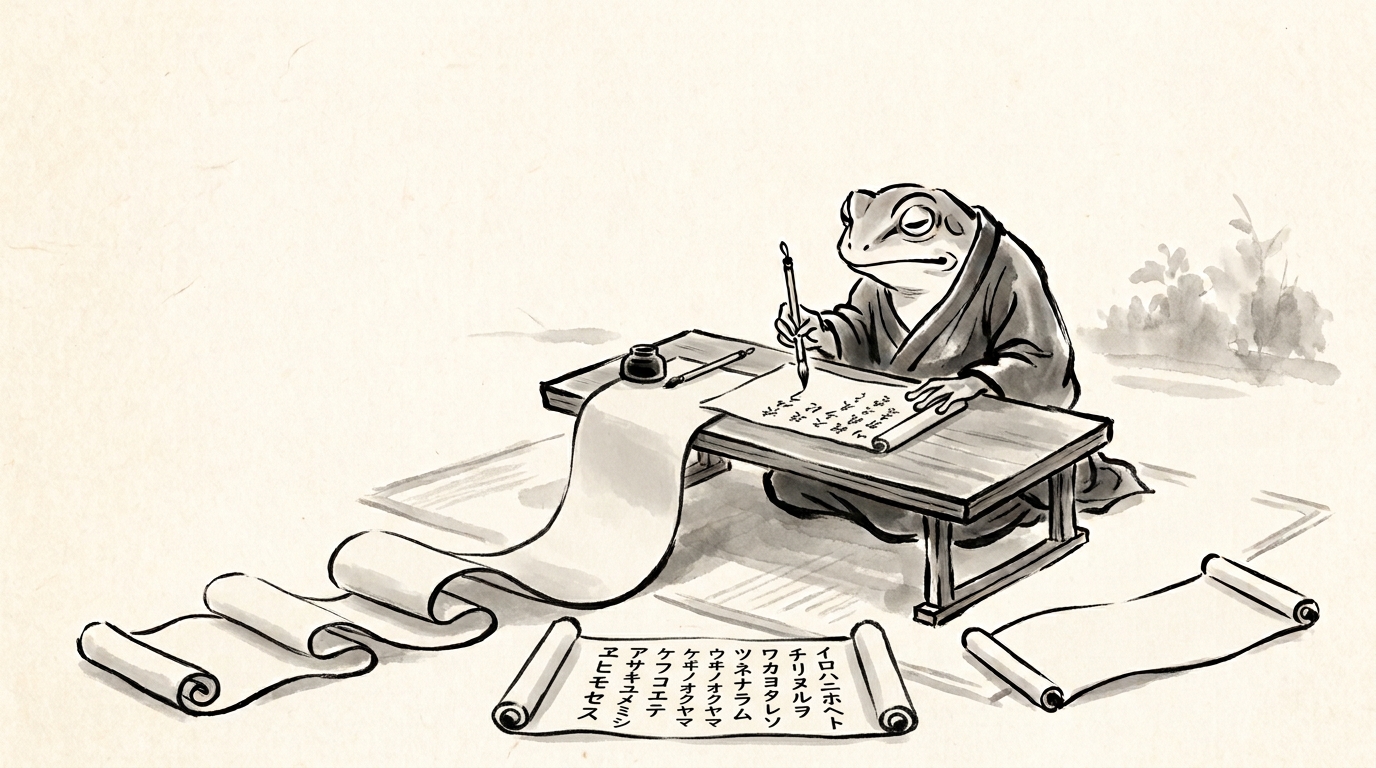
This is the Iroha Uta, an immortal pangram recited for over a thousand years:
Iro ha nihoheto chirinuru wo
Wa ka yo tare so tsune naramu
Uwi no okuyama kefu koyete
Asaki yume miji wehi mo sesu
Rendered into modern English, its meaning unfolds like this:
Though flowers bloom in radiant hues, they inevitably scatter.
In this fleeting world of ours, who could ever remain unchanging?
Today, let us cross the deep mountains of illusion and suffering.
And we shall dream shallow dreams no more, nor be intoxicated by illusions.
Pause for a moment and consider the architectural perfection of this poem.
Using all 47 sounds of a language without repeating a single one is already an extraordinary feat of wordplay. In English, the famous pangram “The quick brown fox jumps over the lazy dog” uses all 26 letters of the alphabet, but it relies on numerous repeated vowels and consonants.
The Iroha poem has zero repetition.
Yet it is far more than a technical puzzle: it seamlessly articulates the core philosophy of Mahayana Buddhism—the reality of Mujo (impermanence). The understanding that all worldly things change, that nothing lasts, and that true peace comes from seeing this truth clearly, is woven directly into the alphabet itself.
Historians still do not know who composed this miracle. While tradition once attributed it to the great Buddhist master Kobo Daishi (Kukai), modern scholarship views it as an anonymous creation composed by monk-scholars in the mid-Heian period. The oldest surviving record dates back to 1079.
For centuries, Japanese children learned to read and write by singing this philosophical hymn. The fact that older dictionaries were arranged in “I-Ro-Ha” order, and that the fundamental basics of any skill are still called “the I of Iroha,” is living proof that this poem once served as the backbone of the entire language.
Why Doesn’t Japanese Use Spaces Between Words?
In modern Japanese, Hiragana primarily serves grammatical functions: grammatical particles (は, が, を, に…), verb inflections (食べる, 歩いた…), and phonetic guides (Furigana).
Here lies one of the greatest mysteries for newcomers studying Japanese:
“Why is there no space between words in Japanese text?”
In English, removing the spaces turns a sentence into an impenetrable wall: “Ilikereadingbooks.” Yet in Japanese, a sentence like 私は本を読むのが好きです (I like reading books) contains zero spaces, and any reader can glide through it effortlessly.
The secret lies in the visual dialogue between Kanji and Hiragana.
Dense, angular 【Kanji】 acts as visual anchors for nouns and verb roots (私 / 本 / 読 / 好). Between these heavy anchors, the looping, fluid 【Hiragana】 (は / を / むのが / きです) weaves like moving water, signaling grammar and tense.
Because the eye instantly registers the stark contrast between blocky Kanji and curving Hiragana, the brain segments the sentence automatically, rendering spaces entirely redundant.
What happens if you write an entire sentence using only Hiragana, without a single space?
Consider this slightly extreme, yet entirely real example:
はははははのひにもらったはなにはなをちかづけてかおりをかいだ
(Hahahahahano hini moratta hanani hanawo chikadukete kaoriwo kaida)
To a non-Japanese eye, it might look like someone laughing (hahahaha…). Even for native Japanese speakers, the brain freezes for a second, desperately scanning for word boundaries.
Now, look at the exact same sentence written normally, with Kanji:
母は母の日にもらった花に鼻を近づけて香りを嗅いだ。
(Mother brought her nose close to the flowers she received on Mother’s Day and smelled their fragrance.)
The difference is night and day.
Because dense 【Kanji】 anchors the key concepts—Mother (母), Mother’s Day (母の日), Flower (花), Nose (鼻), Scent (香り), and Smelled (嗅いだ)—the brain decodes the meaning instantaneously without needing a single space.
Hiragana is far more than a set of phonetic characters. It functions like the breath of the text, giving rhythm, cadence, and visual clarity to the dense weight of Kanji.
A Soft Script That Still Breathes
Hiragana never shouts.
It does not carry the formal gravitas of Kanji, nor does it leap out like the sharp, advertising banners of Katakana.
Yet, when writing a personal letter, or when wishing to convey a quiet, heartfelt emotion, Japanese writers naturally tilt toward Hiragana. Stripped of sharp edges, its looping strokes still carry the warmth of those Heian women who poured their deepest secrets onto paper a thousand years ago.
“Today was a good day.” (今日は、いい日だった)
Even in this humble sentence, the solid pillar of Kanji is gently cradled by the flowing stream of Hiragana.
Shaped by nameless hands that rubbed away the sharp edges of ancient characters, and brought to life by the private longings of classical writers, these 47 sounds continue to form the gentlest, truest pulse of the Japanese language.