We easily fall into the trap of using our own limited experience as the ultimate yardstick to measure the entire world. This story of the “frog in the well” challenges us to expand our horizons, but also offers a beautiful Japanese twist that celebrates the depth of focus over breadth.
井の中の蛙大海を知らず(I no Naka no Kawazu Taikai o Shirazu)
Pronunciation: Ee-noh-nah-kah-noh-kah-wah-zoo, tah-ee-kah-ee-oh shee-rah-zoo.
Meaning: Knowing only one’s narrow world; lacking perspective on the vastness of reality.
Difficulty Level: ⭐⭐⭐⭐⭐/Advanced (N1)
Behind the Phrase
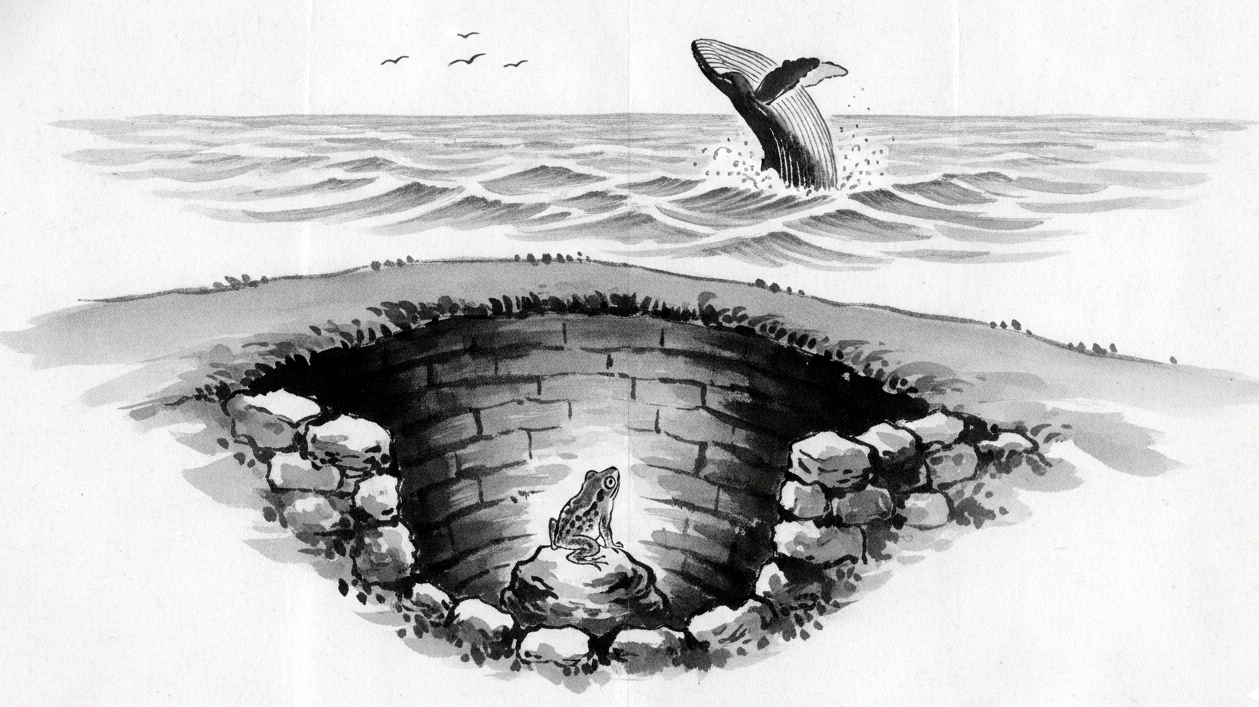
I no naka no kawazu taikai o shirazu (井の中の蛙大海を知らず) is a famous Japanese proverb derived from Chinese philosopher Zhuangzi. It literally means “A frog in a well knows nothing of the great ocean.” It is a cautionary tale about how easily we become arrogant and closed-minded when trapped within our narrow perspectives.
However, in Japan, a positive, poetic second half was added later:
Saredo sora no aosa o shiru (されど空の青さを知る) — “Yet, it knows the blue of the sky.”
This addition honors the shokunin (craftsman) spirit. It suggests that while the frog may be ignorant of the massive world outside, because it remained at the bottom of the well, it was able to stare at the sky through a single lens, understanding its deepest, purest blue better than anyone else. This is my absolute favorite aspect of this idiom.
Author’s Insight
During my college years, I spent most of my time skipping classes to play mahjong and slot machines. I lived in a shallow well, convinced that my immediate pleasures were the center of the universe.
This illusion shattered when my grandfather passed away. As I went through his belongings and learned about how he survived the war and rebuilt his life from the ashes, I was struck by the sheer weight and dignity of his existence. Comparing his lived reality to my empty days of staring at spinning slot reels made me shiver. I realized how small and arrogant I had been, croaking proudly at the bottom of my tiny well.
English Dialogue
A: I’ve worked at this same small bakery for ten years. Sometimes I feel like a frog in a well, completely ignorant of how the fast-paced business world works.
C: You might not know the “corporate world,” but you know exactly how the flour behaves under every season’s humidity. You stayed in that well long enough to see the deepest blue of the sky. That’s a beautiful kind of mastery.
Listen to the Dialogue
📝 Cultural Note for Japanese Learners
The addition “saredo sora no aosa o shiru” highlights a deep cultural appreciation for devotion (专心). In Japan, doing one thing for decades is not seen as “stagnant” but as “mastery.” It is a shift from horizontal expansion (knowing many things) to vertical depth (knowing one thing profoundly).
Wisdom & Summary
In our relationships, we often use our personal “well” to judge others. We label people who are different as “wrong” or “ignorant.”
But this idiom offers a peaceful path. First, it humbles us, reminding us that our view is only a fraction of the world. Second, it teaches us to respect others’ wells. The person you are judging might not know your “ocean,” but they may know a “blue sky” of their own that you have never seen. Approaching others with curiosity rather than judgment is the first step to stepping out of our narrow worlds and building relationships built on mutual respect.
Old wisdom, modern takeaway: You don’t need to sail the entire ocean to know depth; sometimes, looking up from your own well reveals the purest blue in existence.