
Ten’i Muhou: The Seamless Self
Today’s Insight
In a society dominated by filters and social expectations, we constantly feel the need to patch up our vulnerabilities. Yet, ancient wisdom suggests that the most profound connection occurs when we let our armor crumble and show our raw, stitch-less selves.
Behind the Phrase
Ten’i Muhou (天衣無縫) literally means “Celestial robes have no seams.” Based on ancient folklore, the garments of heavenly beings are crafted without a single stitch. Over time, this evolved into a metaphor for art that is so natural it shows no signs of artificial manipulation, and more importantly, a personality that is completely authentic, pure, and devoid of calculation.
Among the vast ocean of Japanese idioms, this phrase holds a special place as the author’s personal favorite, representing the ultimate ideal of living.
Author’s Insight
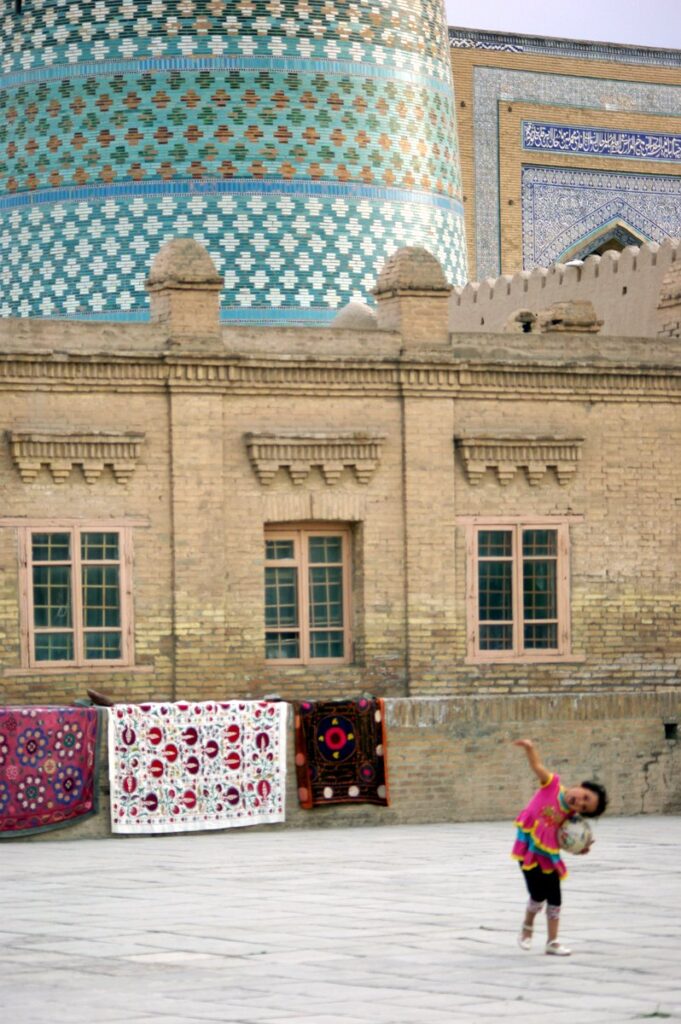
I caught a glimpse of this in a public square in Khiva, Uzbekistan. Surrounded by grand, historic brick structures, a young girl was bouncing a football, chasing it, and laughing. She was completely absorbed in her own world, moving as if she were dancing with the wind. There was no audience-consciousness, no calculated effort to “look good.” Her unadorned presence created a breathtaking, spontaneous beauty that breathed life into the ancient city.
The literary genius of the ancients who coined this phrase is stunning. Instead of directly praising the maiden’s beauty, they focused on her robe—specifically, that it had no seams. By describing the flawless nature of her clothing, they beautifully and indirectly captured the essence of the maiden herself. It is a masterclass in elegant, non-intrusive metaphor.
English Dialogue
A: I always find myself editing my words in group chats, trying to say the “perfect” thing. But it feels like I’m just building a wall between me and everyone else.
C: I get that. But when you stop trying to sound smart and just speak from the heart, that invisible wall crumbles. People feel safe to be themselves around you when you’re real.
📝 Cultural Note for Japanese Learners
In Japanese philosophy, Ten’i Muhou is closely linked to the Zen concept of Mufunbetsu (non-discrimination)—a state of mind where one abandons the dualistic struggle of “self versus other” and “showing versus hiding.” In modern psychology, this is the very foundation of building “Psychological Safety.”
Wisdom & Summary
In our daily interactions, we often wear psychological armor, driven by cognitive biases to protect our egos, while labeling and judging those around us. These artificial “stitches” build high walls between our hearts.
However, when you let go of calculation and show up as your true self (Jitōmyō – being your own light), you break down those invisible barriers. This vulnerability fosters “Empathic Understanding,” prompting others to drop their guard as well. By leaving your robe stitch-less, you create an environment where genuine trust can finally take root.
Old wisdom, modern takeaway: True trust is not built by perfect presentation, but by the seamless ease of being your authentic self.